
What Is AI Literacy — And Why Your Child Needs It More Than Another Maths Tutor

"AI literacy" has become one of the most used phrases in education — and one of the least clearly defined. Schools mention it. Governments reference it in policy documents. Technology companies claim their products deliver it. But if you asked most people to explain what AI literacy actually means, specifically, you would get very different answers.
Three things AI literacy actually is
UNESCO’s AI Competency Framework for Students (2022) defines AI literacy across three interconnected dimensions. Understanding AI — knowing what AI systems do, how they work, and what their limitations are. Using AI critically and ethically — applying tools purposefully, evaluating outputs, engaging with questions of fairness and accountability. Creating with AI — using AI as a genuine intellectual collaborator, not a search engine or shortcut.
Why this matters more than another maths tutor
The WEF Future of Jobs Report 2025 projects that 39% of core workplace skills will change by 2030. Employers are shifting toward skill-based hiring, with 77% committed to reskilling their workforces to work alongside AI. At SAIL (Scholastic Artificial Intelligence Learning), AI literacy is the foundational framework around which every course is built. The WEF estimates 65% of children now entering primary school will work in job categories that do not yet exist. That adaptability is not a bonus. It is the whole point.
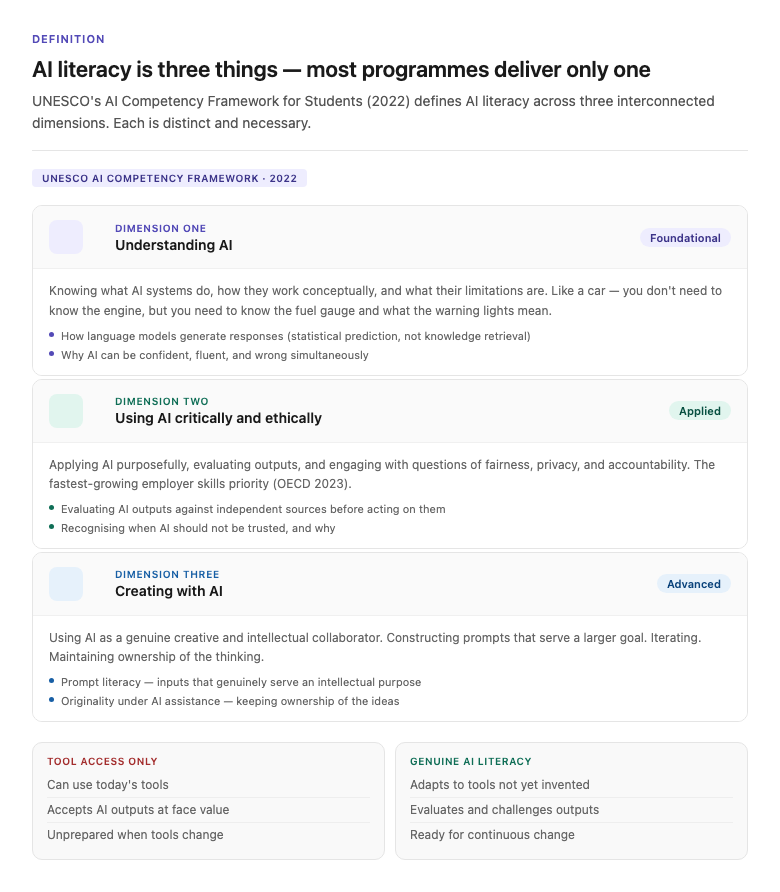
The three dimensions
Understanding AI — Foundational. Knowing how AI systems work, what their limitations are, why outputs require evaluation. Most schools do not teach this dimension.
Using AI critically and ethically — Applied. Deploying tools purposefully, evaluating what they produce, engaging with questions of fairness and accountability. Fastest-growing employer priority (OECD 2023).
Creating with AI — Advanced. Using AI as a genuine intellectual collaborator. Constructing prompts that serve a larger goal. Maintaining ownership of the thinking.
Comments