
How to Evaluate an AI Education Programme: 6 Questions Every Parent Should Ask

Not all AI education programmes are the same. Some are excellent. Some use the language of AI literacy without delivering the substance. As the market grows — the global AI in education sector is projected by Emergen Research to reach USD 38.2 billion by 2034 — the gap between genuine programmes and well-marketed ones is widening.
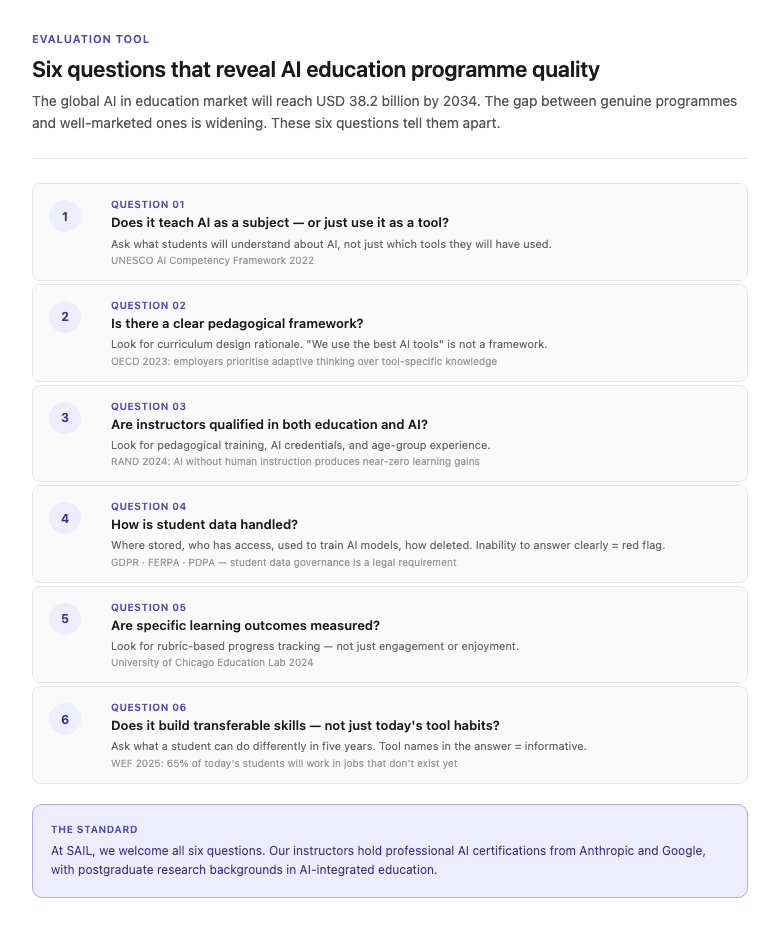
This guide gives parents, schools, and adult learners a practical framework for evaluating any AI education programme. Six questions. Each one targets a specific dimension of quality.
Question 1: Does the programme teach AI or just use it?
According to UNESCO’s 2022 AI Competency Framework, genuine AI literacy requires three interconnected capabilities: understanding how AI works, applying it critically and ethically, and creating with it purposefully. A programme that covers only tool use is not delivering AI literacy.
Question 2: What is the pedagogical framework?
AI is a means, not an end. According to the OECD’s 2023 report, the skills employers value most are adaptive thinking, problem solving, and critical evaluation — not tool-specific knowledge. A programme whose framework is simply “we use the best AI tools” is optimising for the wrong thing.
Question 3: Who is teaching, and what are their qualifications?
A 2024 report from the RAND Corporation found that AI tutoring deployed without concurrent human instruction produced effect sizes near zero. The human educator is not optional — they are the variable that makes everything else work.
Questions 4–6: Data, outcomes, and transferable skills
How is student data handled? Ask: where stored, who has access, used to train AI models, how deleted. How are learning outcomes measured? Look for rubric-based progress tracking, not just engagement metrics — the University of Chicago Education Lab 2024 found the strongest outcomes tied to rubric-specific feedback. Is the programme preparing students for what comes next? The WEF 2025 projects 65% of today’s students will work in jobs that don’t exist yet.
A note on how SAIL measures up
At SAIL (Scholastic Artificial Intelligence Learning), we welcome these questions. Our instructors hold professional AI certifications from Anthropic and Google with postgraduate research backgrounds in AI-integrated education. If you would like to put any of these six questions to us directly, we would welcome the conversation.
Comments