
A Parent's Complete Guide to AI in Education: What It Is, What It Isn't, and What to Ask

If your child's school has mentioned artificial intelligence, or if you have seen the phrase "AI education" and wondered what it actually means in practice, you are not alone. AI has become one of the most discussed topics in education globally — and also one of the most misunderstood.
This guide is written for parents who want a clear, honest picture: what AI in education actually is, what it is not, and how to evaluate whether a programme is worth your child's time.
What AI in education actually means
At its most basic, artificial intelligence refers to computer systems that can perform tasks that would normally require human intelligence — recognising patterns, generating text, answering questions, making predictions. In education, AI appears in two distinct forms.
The first is AI as a tool — software that teachers or students use to support learning. AI writing assistants, tutoring systems, quiz generators, adaptive platforms. The second — and far less common — is AI as a subject. Teaching students to understand how AI works, not just how to click a button. This is the approach SAIL (Scholastic Artificial Intelligence Learning) takes. These two things are often confused. The distinction matters enormously.
What AI in education is not
AI in education is not about replacing teachers. The World Economic Forum's Future of Jobs Report 2025 is explicit: the skills growing fastest in value — critical thinking, collaboration, adaptability, problem solving — are precisely the skills that require skilled human educators to develop. AI is most powerful in education when it works alongside a teacher, not in place of one.
AI in education is also not a guaranteed shortcut to better results. A 2024 study from the University of Chicago Education Lab found that AI tutoring produces significant learning gains — but only when used consistently, purposefully, and in conjunction with classroom instruction. Passive access to AI tools without structured guidance produces little measurable benefit.
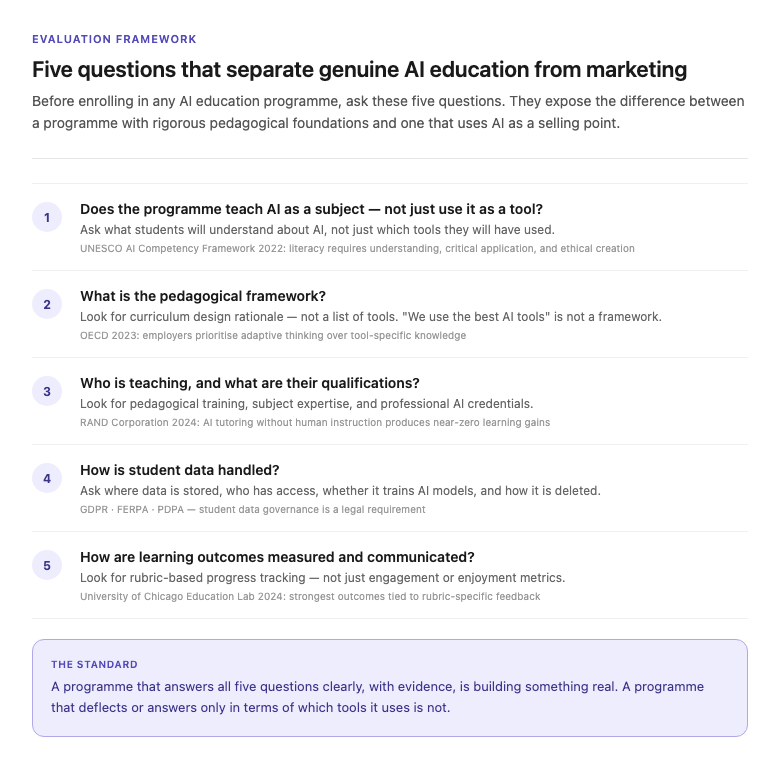
Five questions to ask any AI education programme
1. Does the programme treat AI as a tool or as a subject? A programme that teaches genuine AI literacy — how AI works, how to evaluate it, how to use it ethically — is offering something considerably more valuable.
2. What is the pedagogical framework? AI is a means, not an end. A credible programme explains its educational philosophy. "We use the latest AI tools" is not a pedagogical framework.
3. How does the programme handle data and privacy? Any programme involving student data should explain clearly how that data is stored, who has access, and how it is protected.
4. How are learning outcomes measured? A serious programme points to specific, observable outcomes: skills developed, assessments completed, progress tracked.
5. Is there a qualified human educator at the centre? AI can generate content and provide feedback. It cannot build the relationship and mentorship that drives long-term learning.
A note on what SAIL offers
At SAIL, we designed our courses around all five criteria. Our programmes are taught by qualified educators with research-backed training in AI-integrated pedagogy. We teach AI as a subject — building the critical thinking, ethical reasoning, and practical skills that students will carry with them regardless of which industries or roles the future creates.
The distinction that matters
Tool access only: can use today's tools, accepts AI outputs at face value, unprepared when tools change
Genuine AI literacy: adapts to tools not yet invented, evaluates and challenges outputs, directs AI toward original thinking
Comments