
The Evidence Is In: AI-Integrated Learning Improves Student Outcomes

I want to tell you about a problem that has haunted education researchers for forty years — and why I genuinely believe we are now, for the first time, close to solving it.
One-to-one tutoring at scale: a 40-year problem, now solvable
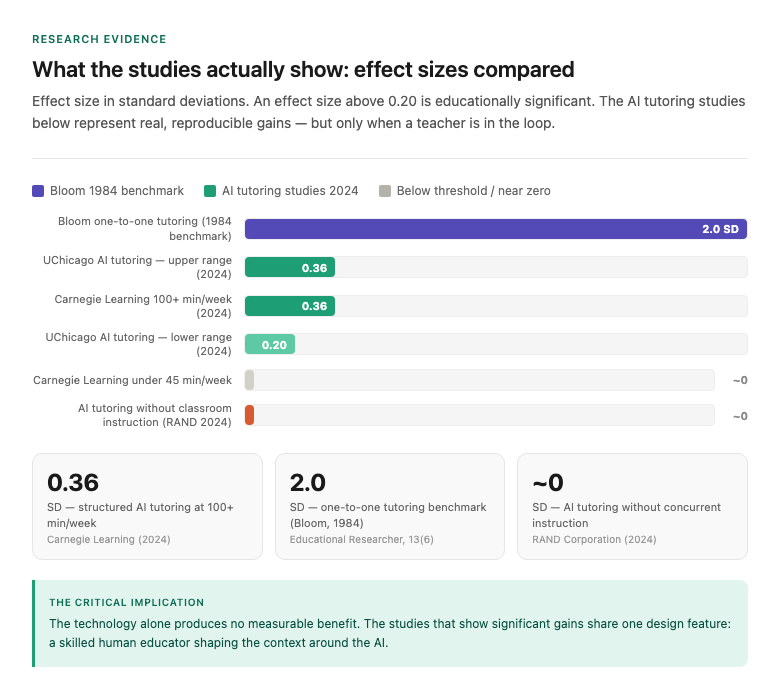
In 1984, educational psychologist Benjamin Bloom published one of the most cited findings in the history of education research. His "2-Sigma Problem" demonstrated that students who received one-to-one tutoring consistently outperformed students receiving conventional classroom instruction by two standard deviations. The average tutored student performed better than 98% of students in traditional classrooms. The problem was that one-to-one instruction was not economically scalable.
Here is the analogy I keep coming back to: imagine you have a Formula 1 pit crew watching every lap, adjusting the car after every corner. That is what one-to-one tutoring does for learning. Conventional classroom teaching is more like a scheduled service every 10,000 miles. For forty years, we have not been able to give every student their own pit crew. AI is beginning to change that.
A landmark 2024 study from the University of Chicago Education Lab found that students using AI tutoring platforms for 30 minutes per day, four days per week, improved their academic performance by 0.20 to 0.36 standard deviations within a single semester. The study identified three keys to effectiveness: adaptive difficulty calibration, Socratic questioning rather than answer-giving, and integration with classroom instruction.
Why design matters more than the technology
Carnegie Learning’s longitudinal data from 2024 showed that students using its AI-powered MATHia platform for more than 100 minutes per week achieved effect sizes of 0.36 standard deviations. Students using the same platform for fewer than 45 minutes per week showed no measurable improvement. A 2024 report from the RAND Corporation found that AI tutoring deployed without concurrent classroom instruction produced effect sizes near zero. The technology alone, without the teacher, is largely inert.
What this means for students in Cambodia
According to the OECD, approximately 27% of jobs across OECD economies are already in occupations with high exposure to automation. The WEF projects that 65% of children entering primary school today will work in roles that do not yet exist. The evidence for AI-integrated education is no longer theoretical. At SAIL (Scholastic Artificial Intelligence Learning), we build all three keys — adaptive calibration, Socratic prompting, and teacher integration — into every session we run.
Three keys that make AI tutoring work
Adaptive difficulty calibration — the system continuously adjusts complexity based on real-time performance data
Socratic questioning — the AI prompts students to reason through problems rather than presenting answers
Integration with classroom instruction — AI tutoring woven into teacher-led learning rather than used in isolation (RAND Corporation 2024: AI without human instruction = near-zero gains)
Comments