
Five Ways AI Is Changing What It Means to Be a Good Teacher

I want to start with something I have noticed across years of teaching. The teachers I have seen thrive with AI are not the ones who use it the most. They are the ones who understood, quite quickly and instinctively, that AI was going to change what their job actually required of them — and leaned into that change rather than managing around it.
1. The shift from information delivery to intellectual coaching
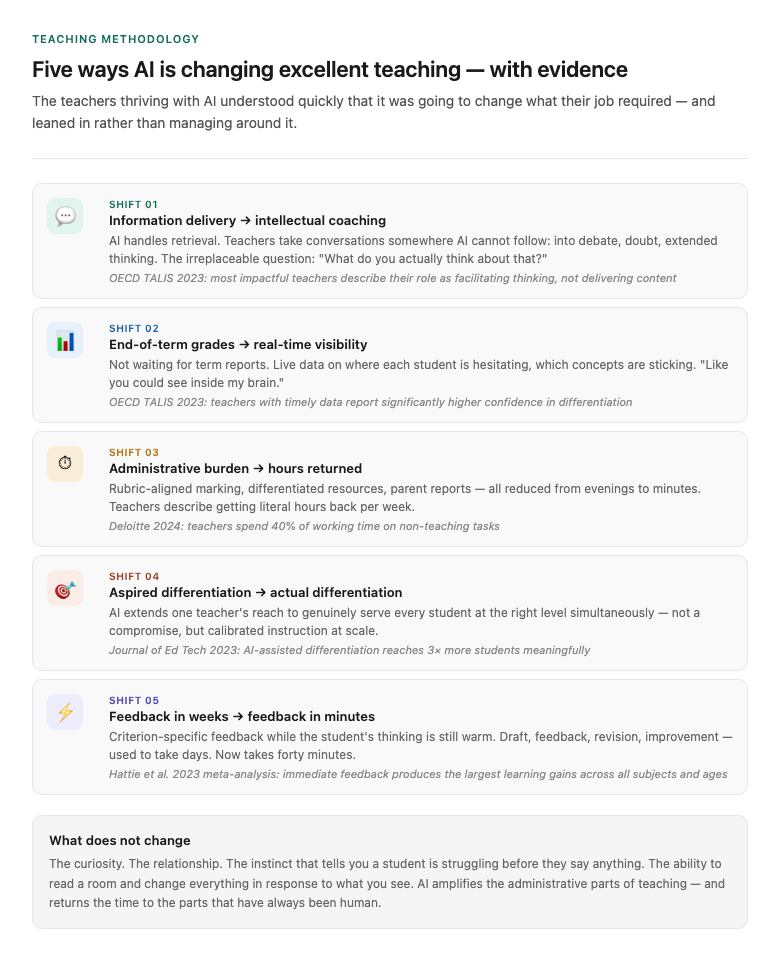
According to the OECD’s 2023 Teaching and Learning International Survey, the most impactful teachers are increasingly those who describe their primary role not as content delivery but as facilitating student thinking. AI handles information retrieval exceptionally well. What it cannot do is sit across from a student and ask, in just the right way at just the right moment: “But what do you actually think about that?”
2. Real-time visibility into every student
Not end-of-term grades. Real-time visibility into what each student is doing, where they are hesitating, which concepts are sticking. According to the OECD’s TALIS 2023 findings, teachers who receive consistent, timely data on individual student progress report significantly higher confidence in their ability to differentiate instruction.
3. Administrative load that actually decreases
A survey published by Deloitte in 2024 found that teachers in OECD countries spend an average of 40% of their working time on tasks that are not direct instruction. AI reduces this burden measurably. Rubric-aligned feedback that used to take an evening now takes minutes.
4. Differentiation that is actually possible
According to research published in the Journal of Educational Technology in 2023, teachers using AI-assisted differentiation tools report being able to provide meaningful individual adaptation for up to three times as many students as they could manage manually. I see this directly at SAIL (Scholastic Artificial Intelligence Learning).
5. Feedback loops that close in minutes, not weeks
According to a 2023 meta-analysis by Hattie and colleagues, immediate feedback produces learning gains significantly larger than delayed feedback across virtually all subject areas and age groups. At SAIL, students receive criterion-specific feedback on their writing within minutes of submission — while they are still in the room.
What stays the same
None of this replaces what a good teacher actually is. The curiosity, the relationship, the instinct that tells you a student is struggling before they say anything — AI does not touch any of that. It amplifies the parts of teaching that have always been administrative and returns them to the parts that have always been human.
Comments