
The 40-Year Case for Personalised Learning — And Why AI Finally Makes It Possible at Scale

Why do wealthy families spend so much money on private tutors? Not for status. Because personalised instruction works — and AI is, for the first time, changing who can access it. According to Grand View Research, the global private tutoring market is projected to exceed USD 200 billion by 2030.
Vygotsky’s Zone of Proximal Development — the space between what a student can do independently and what they can achieve with guidance — is the theoretical foundation. Like training wheels on a bicycle: precisely calibrated to where the learner actually is, removed the moment they no longer need them. According to OECD data, teachers spend fewer than two minutes in one-to-one interaction with any individual student during a typical lesson. AI changes this.
A 2024 analysis from McKinsey Global Institute found that AI-powered personalised learning tools have the greatest potential to improve outcomes for students in under-resourced settings. This is a structural shift in who gets access to what has always been the most effective form of instruction. At SAIL (Scholastic Artificial Intelligence Learning), AI gives our instructors real-time data to make human decisions with.
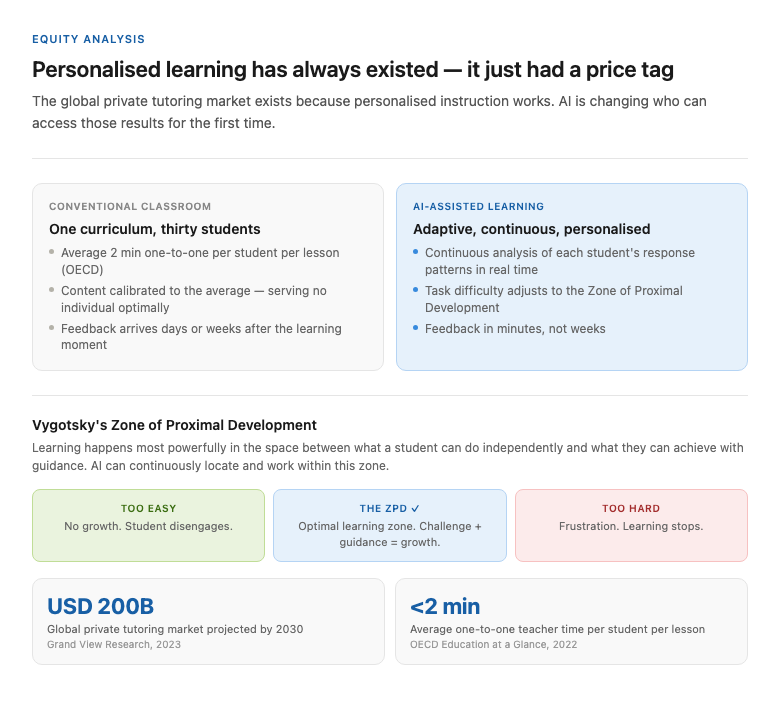
The equity gap in numbers
Global private tutoring market: projected USD 200B by 2030 (Grand View Research, 2023)
Average one-to-one teacher time per student per lesson: fewer than 2 minutes (OECD, 2022)
AI personalised learning: greatest gains for students in under-resourced settings (McKinsey, 2024)
Socioeconomic background: strongest predictor of educational outcome across OECD (PISA data)
Comments