
Beyond ChatGPT: What Genuine AI Literacy Actually Looks Like for Students

There is a version of AI literacy spreading through schools right now, and I want to be honest about what it actually is. A student opens a browser. Types a question into ChatGPT. Reads the response. Copies the useful parts. Their teacher calls this “using AI in learning.” What has actually been learned? How to retrieve information from a system they do not understand, cannot evaluate, and have no particular reason to question. This is not AI literacy. It is AI dependency with an educational label on it.
The retrieval trap
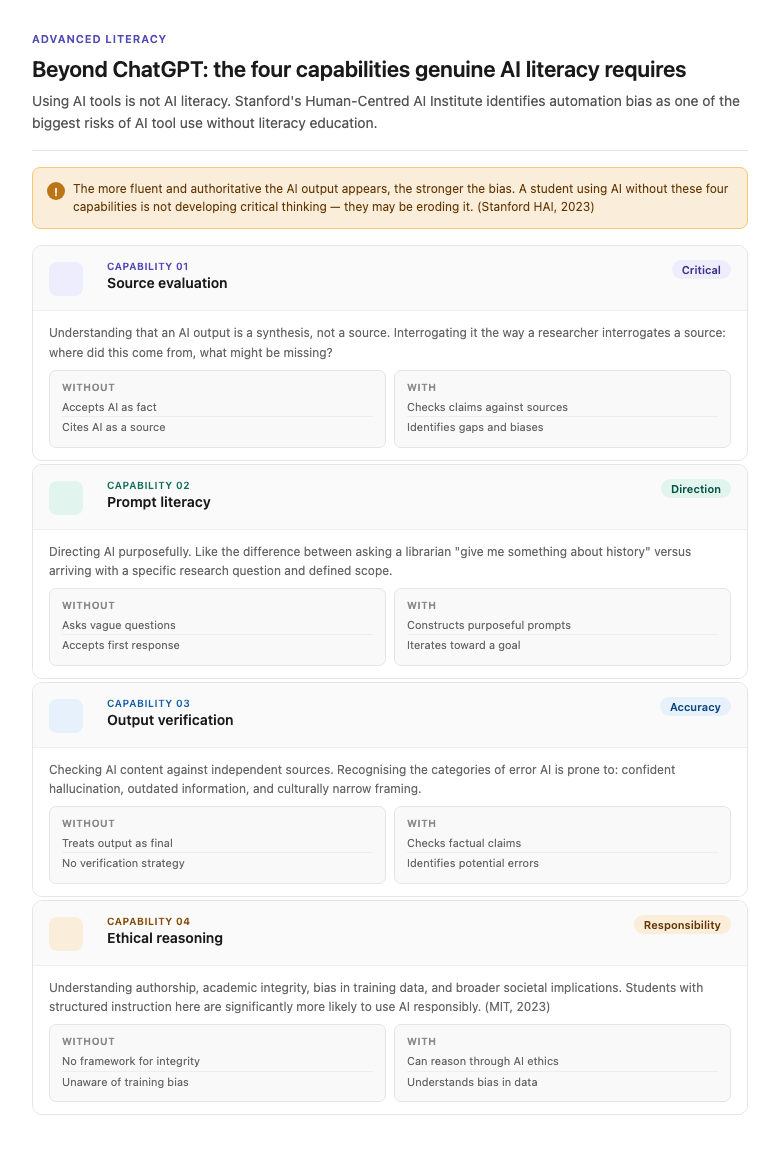
Research from Stanford University’s Human-Centred AI Institute has identified “automation bias” as one of the most significant risks of AI tool use without accompanying literacy education. Automation bias is the documented tendency for people to over-rely on automated system outputs, reducing their own independent critical evaluation even when the system is producing errors. The more fluent and authoritative the output appears, the stronger the bias. A student who uses AI tools without understanding this dynamic is not developing critical thinking — they are potentially eroding it.
The four capabilities genuine AI literacy requires
Source evaluation: understanding that an AI output is not a source, it is a synthesis. Prompt literacy: the ability to direct an AI system purposefully — the difference between asking a librarian “give me something about history” and arriving with a specific research question and defined scope. Output verification: the habit of checking AI-generated content against independent sources. Ethical reasoning: understanding authorship, academic integrity, bias in training data, and broader societal implications.
Why this matters more than it might seem
According to the OECD’s 2023 report, the ability to simply use AI tools is rapidly commoditising. The most valuable workers will be those who can direct AI purposefully, evaluate its outputs critically, and apply judgement the AI cannot provide. At SAIL (Scholastic Artificial Intelligence Learning), we build all four capabilities deliberately, in every course.
Comments