
Why We Built SAIL: A Founders' Perspective on AI and the Future of Learning

Nobody knows exactly what the world will look like when today's students enter the workforce. That is not a pessimistic statement. It is simply the most honest one available to any educator right now — and it is the conviction that led us to build SAIL (Scholastic Artificial Intelligence Learning).
The evidence for this uncertainty is substantial. The World Economic Forum's Future of Jobs Report projects that around 65% of children entering primary school today will ultimately work in jobs that do not yet exist. The OECD reinforces this: approximately 27% of jobs across OECD economies are already in occupations with high automation risk. Research from McKinsey Global Institute estimates that 60 to 84% of tasks within highly exposed roles can potentially be automated or assisted by AI.
The research gives us a clear answer. According to the WEF's Future of Jobs Report 2025, skills such as digital literacy, critical thinking, collaboration, and adaptability are becoming more valuable than static knowledge. Employers are shifting toward skill-based hiring. The same report finds that 39% of core workplace skills are expected to change by 2030.
This is where we come in
We are Carl and Terry, the co-founders of SAIL. We arrived at the same conviction from different directions.
Carl spent a decade teaching across China and Southeast Asia before making Cambodia home. He holds a Master’s degree in International Education from Liverpool John Moores University, is a certified Anthropic AI educator, holds Google AI certification, and is a Pearson-qualified IELTS instructor with Cambridge iGCSE and A-Level expertise. Through his postgraduate research, one question kept surfacing: what does it actually mean to prepare a student for AI — not as a passive user, but as someone who understands it, works with it, and can critically evaluate what it produces?
Terry’s answer came from the ground up — nearly eight years of teaching and educational leadership in Cambodia. A PGCE, a Master of Education in progress, and hundreds of students mentored along the way. What that classroom experience made unmistakably clear: no two learners are the same, and a curriculum designed for the average student serves no student particularly well.
SAIL was built at the intersection of those two insights. A research-informed understanding of where the world is heading. A practitioner’s understanding of how individual students actually learn.
What AI literacy actually means
Genuine AI literacy, as defined by UNESCO’s AI Competency Framework for Students and Teachers, means understanding how AI systems work, recognising what they do and do not do well, evaluating their outputs critically, using them purposefully as part of a larger intellectual process, and engaging with them ethically. These are the capabilities that translate across industries, across roles, and across whatever the next decade of technological change produces.
We take seriously that AI carries responsibilities. Carl’s postgraduate research explored the conditions under which AI in education delivers on its promise — and the conditions under which it falls short. That research directly informs how SAIL designs its curriculum: which tools we use, how we teach students to interrogate rather than simply accept AI outputs, and why ethical reasoning is a core part of every course we run.
The question that matters
The students now sitting in classrooms across Cambodia will spend their careers working alongside AI. Some will direct it. Some will build with it. All of them will need to understand it. The question is not whether AI will reshape the global workforce — that is already underway. The question is whether students will be equipped to shape how AI is used, or simply subject to decisions made by those who are.
SAIL is actively enrolling students for our in-person programmes in Cambodia. Whether you are a parent looking to give your child a genuine advantage, a student ready to take your learning seriously, or a school seeking to understand what AI-integrated education looks like in practice — we would welcome the conversation.
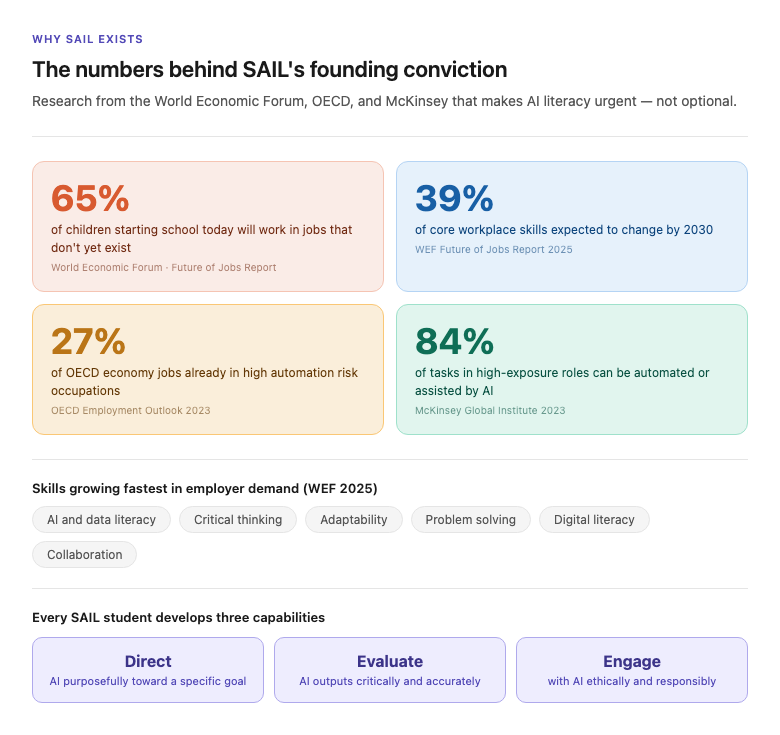
The numbers behind SAIL’s founding conviction
65% of children entering primary school today will work in jobs that do not yet exist — World Economic Forum
39% of core workplace skills expected to change by 2030 — WEF Future of Jobs Report 2025
27% of OECD economy jobs already in high automation risk occupations — OECD Employment Outlook 2023
77% of employers committed to reskilling workforces alongside AI — WEF 2025
Comments