
Inside SAIL's Classroom: How We Actually Teach with AI

One of the things I love most about teaching is the moment a student stops waiting to be told something and starts figuring it out themselves. That shift — from passive to active, from receiver to thinker — is what teaching is actually for. When you add AI to that environment thoughtfully, something genuinely exciting occurs.
Phase one: conceptual grounding
Before a student touches any AI tool, we spend time understanding what it actually is and how it works — at the level that matters for a learner: what is this thing doing when it responds to me? A twelve-year-old once told me, after we had worked through how a language model generates text, that it was “like autocomplete that read the whole internet.” The point is that he had a mental model he owned — not just a tool he was told to use. UNESCO’s 2022 AI Competency Framework identifies this foundational understanding as the bedrock of genuine AI literacy.
Phase two: directed application
Students work with AI on structured tasks. The key design principle: AI assists but never completes. One student, working on a persuasive writing task, told me she had rewritten her introduction four times because the AI kept showing her it was not quite landing. “It is like having someone who always has time to read it again,” she said. The cognitive work stayed with her. The AI accelerated the feedback loop.
Phase three: critical reflection
Students evaluate what the AI produced: where was it helpful, where did it fall short, what did they have to do themselves? Carnegie Learning’s 2024 longitudinal research confirms this is where the deepest learning occurs.
How we personalise within a group setting
Benjamin Bloom demonstrated in 1984 that one-to-one tutoring produces learning gains roughly two standard deviations above conventional classroom instruction. AI helps us get much closer to this ideal. Within a single SAIL (Scholastic Artificial Intelligence Learning) session, students who are ahead are working on genuinely extended challenges while students who need consolidation get exactly the targeted support they need.
Every time I see a student push back on an AI output — notice that it has missed something, or made an assumption that does not hold — I think: that is the skill. The technology in our classroom is genuinely exciting. But it is the thinking we build around it that matters.
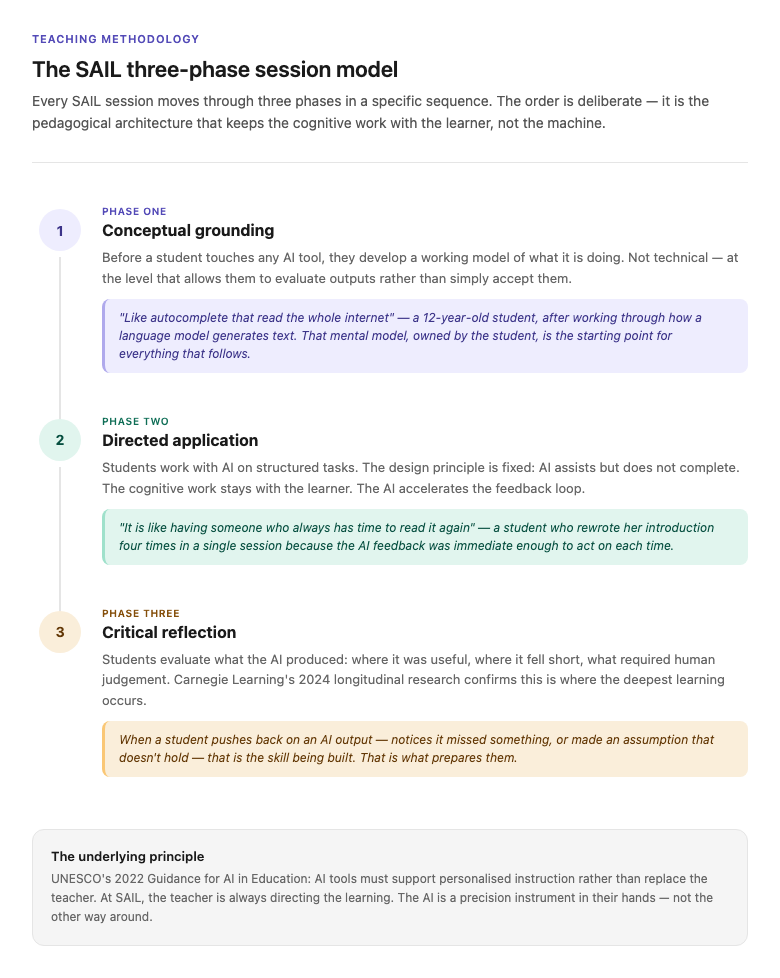
The underlying principle
UNESCO’s 2022 Guidance for AI in Education: AI tools must support personalised instruction rather than replace the teacher. At SAIL, the teacher is always directing the learning. The AI is a precision instrument in their hands — not the other way around.
Comments