
What Cambodia's First EdTech Summit Tells Us About the Future of Education Here

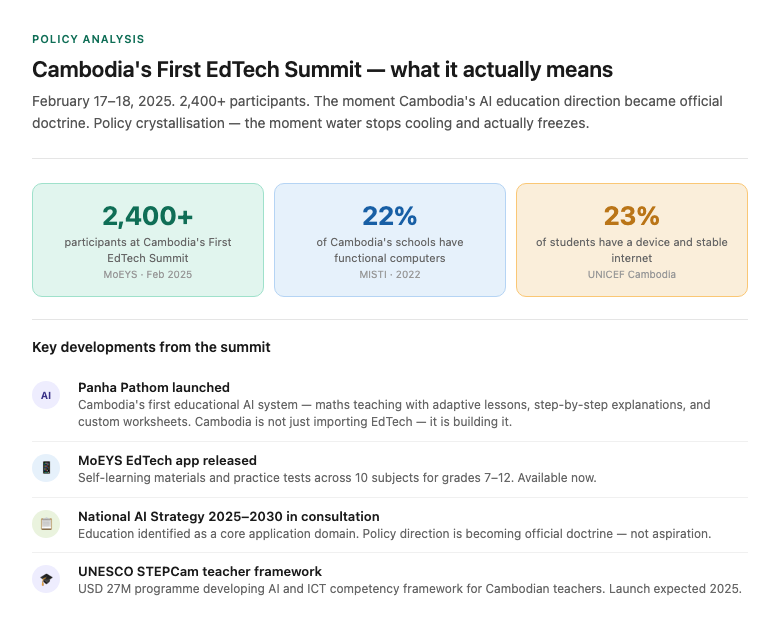
On February 17 and 18, 2025, Cambodia’s Ministry of Education, Youth and Sport hosted the country’s first EdTech Summit at the Institute of Technology of Cambodia. Over 2,400 participants attended — policymakers, educators, technology companies, and international development partners. The theme was “Cambodia’s Path to Digital Education.”
The signal beneath the summit
Events like this are often read as announcements. I think they are better read as confirmations. What the summit marked was the point at which the government’s engagement with AI in education became formal, structured, and publicly committed. The technical term: policy crystallisation — the moment when direction forming in institutional thinking becomes official doctrine.
Minister Hang Chuon Naron stated clearly that the Ministry’s commitment is to ensure the next generation can obtain new digital skills, especially AI, in response to the job market. Panha Pathom — Cambodia’s first educational AI system — was introduced for mathematics teaching.
What the infrastructure data tells us
According to a 2022 report from Cambodia’s Ministry of Industry, Science, Technology and Innovation, only 22% of schools in Cambodia have functional computers. According to UNICEF Cambodia data, only approximately 23% of students have both an ICT device and a stable internet connection. The ambition expressed at the EdTech Summit runs ahead of the infrastructure currently available to deliver it everywhere.
I find the gap between ambition and infrastructure not discouraging but clarifying. SAIL (Scholastic Artificial Intelligence Learning)’s in-person courses in Phnom Penh are not waiting for national infrastructure to catch up. A student who understands how AI works, who can direct it purposefully and evaluate its outputs critically, will be equipped to use whatever technology arrives in their school or workplace — whenever it arrives.
Comments