
UNESCO's New AI Framework for Teachers: What It Means for Classrooms Across Southeast Asia

When UNESCO publishes a framework, it is easy to file it mentally alongside other policy documents. I want to make the case that the UNESCO AI Competency Framework for Teachers deserves a different reception. What it describes is a precise diagnosis of exactly the gap that SAIL (Scholastic Artificial Intelligence Learning) was built to address.
UNESCO’s AI Competency Framework for Teachers, launched in 2024, defines five progressive levels of AI competency. Think of learning a musical instrument: you do not begin by improvising jazz. You build from understanding what notes are, through to composing original music. The framework works the same way.
Cambodia is not a passive observer. UNESCO’s STEPCam programme — a USD 27 million initiative funded by the Global Partnership for Education — is developing exactly this kind of AI and ICT competency framework for Cambodian teachers, with a launch expected in 2025. The policy environment is moving.
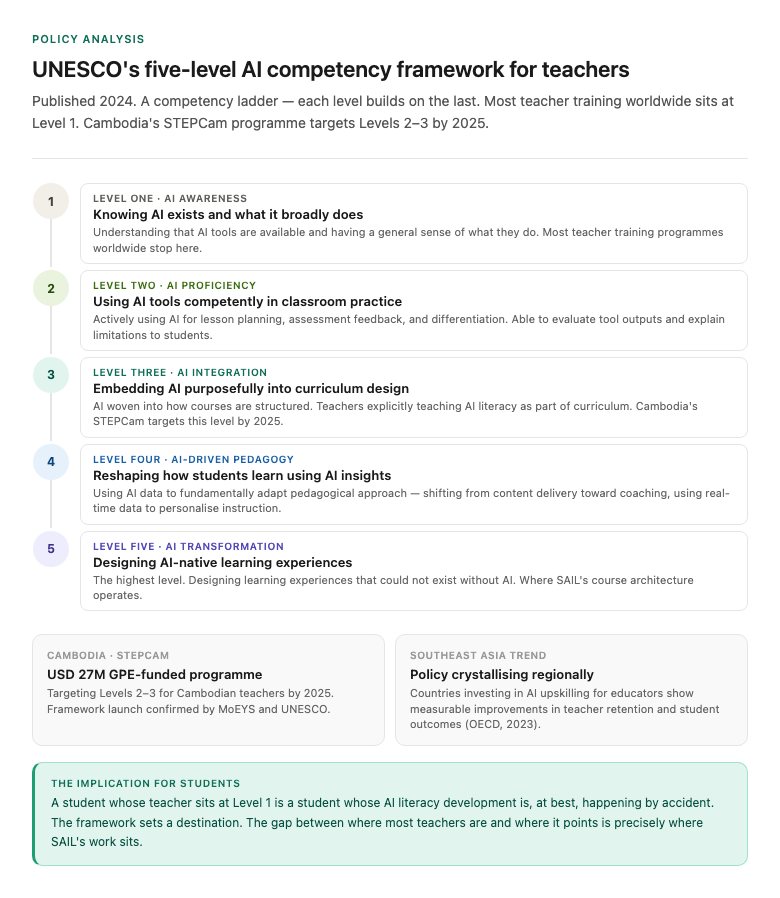
The five levels
AI awareness — Understanding that AI tools exist. Most teacher training worldwide stops here.
AI proficiency — Using AI tools competently in classroom practice.
AI integration — Embedding AI purposefully into curriculum design. Cambodia’s STEPCam targets Levels 2–3 by 2025.
AI-driven pedagogy — Reshaping how students learn using AI insights.
AI transformation — Designing AI-native learning experiences. Where SAIL’s course architecture operates.
Comments