
The Future of Learning Is Adaptive: Where AI Education Is Heading in 2025 and Beyond

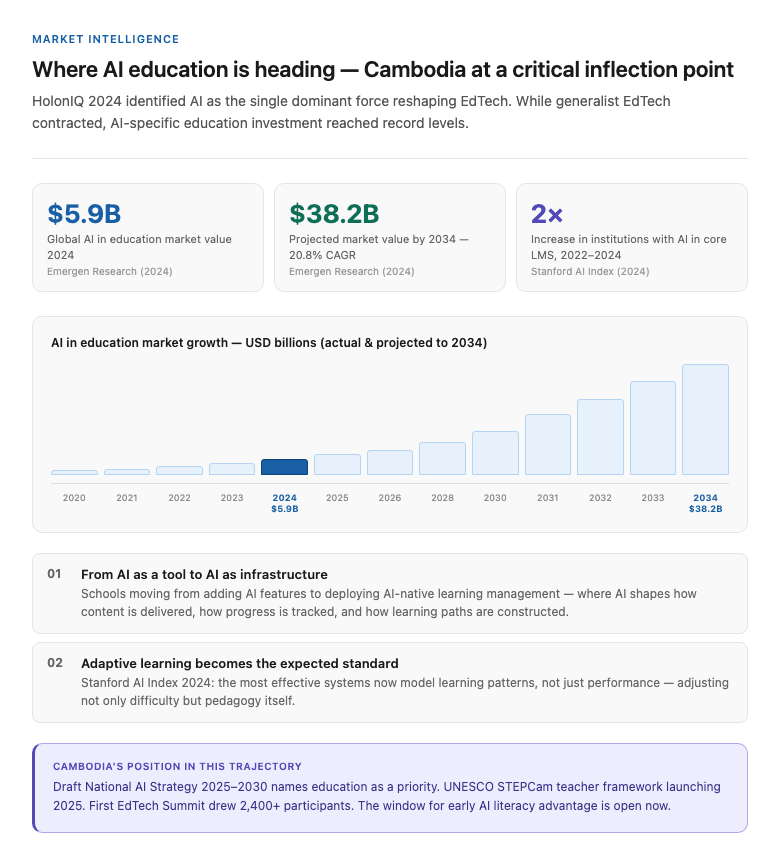
Every year, HolonIQ — one of the leading global intelligence platforms tracking the education industry — publishes data on what is actually happening in EdTech investment and adoption worldwide. Their 2024 Global EdTech Market report identified AI as the single dominant force reshaping education technology, with global AI in education investment reaching record levels despite a broader EdTech funding downturn.
From tools to infrastructure
The first and most important trend is the move from AI as a classroom tool to AI as educational infrastructure. What is emerging now is AI-native learning management — platforms where the AI is not a feature but the architecture. According to Stanford University’s 2024 AI Index Report, the number of education institutions actively integrating AI into core learning management systems doubled between 2022 and 2024.
What adaptive learning actually looks like at scale
According to the Stanford AI Index 2024, the most effective AI learning systems now model not just performance but learning patterns — adjusting not just difficulty but pedagogy. According to the World Economic Forum’s Future of Jobs Report 2025, the fastest-growing skills priorities for employers globally now include AI and big data literacy alongside adaptability and critical thinking.
What this means specifically for Cambodia
Cambodia’s government Draft National AI Strategy 2025–2030 explicitly prioritises education as a core application domain. UNESCO’s STEPCam programme is developing AI competency frameworks for Cambodian teachers. The First Cambodia EdTech Summit drew more than 2,400 participants. The window to develop genuine AI literacy — before it becomes an assumed baseline rather than a competitive advantage — is open right now.
SAIL (Scholastic Artificial Intelligence Learning) was not built in response to a trend. It was built in response to a gap. The trends described above are, from where we stand, simply the world catching up to what good AI education already looks like.
Comments